
Coloring Pages: Read Words and Symbols as Part of the Picture
The main flower, vehicle, or landscape may catch your attention before you notice a small sign, caption, or emblem nearby. When browsing free coloring pages pdf resources, that extra content belongs to the picture too. Read what is readable, identify what remains uncertain, and decide whether the complete drawing fits what you want. You do not need to decode every decorative mark, but an essential message deserves the same attention as the subject that first attracted you.
1. Scan the whole picture for content beyond the main subject
A quick look around the drawing can reveal wording and marks outside its main object. Include those details without assuming every ornament carries a separate message.
1.1 Notice wording inside and around the drawing
Imagine a garden scene with a small sign beside the main flower. If the sign contains readable wording, consider it along with the flower before selecting the picture. Look around the outer areas as well as the center: a banner, caption, or slogan can sit away from the main subject. A vehicle may likewise have lettering on its side. You may like the vehicle first, but the lettering is still part of the drawing. These are hypothetical arrangements, not claims about particular collection items.
- Scan the center, edges, signs, and objects for visible wording.
- Separate readable text from letters that are too small or partly hidden.
- Include any message that could affect your choice before selecting the design.
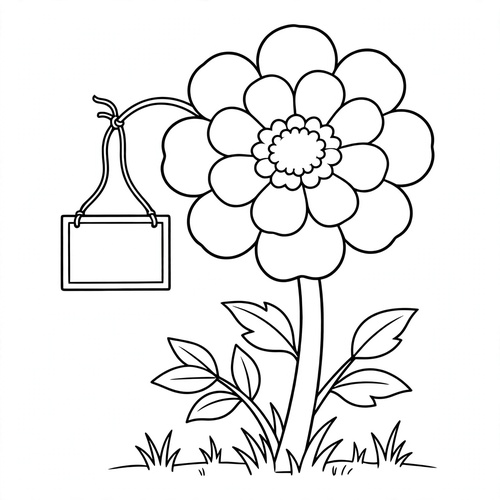
Large garden flower beside a small blank hanging sign
1.2 Look for marks that may carry a separate meaning
Notice an emblem or repeated mark when it could affect your choice. Begin with its visible form: where it appears, whether it is distinguishable, and what you can observe. A shape may be ordinary decoration or carry a meaning you do not know. Do not decide that every ornament is significant, and do not assign a familiar meaning to an unfamiliar mark merely because the theme suggests it. Observation comes before interpretation.
2. Separate what you can read from what you assume
Unreadable wording, unfamiliar language, and an unfamiliar symbol are different uncertainties. The next useful check depends on which information is missing and whether it matters. This distinction is useful when comparing printable coloring pages pdf resources, because a clear subject does not guarantee that every small message or symbol is equally legible.
2.1 Keep partly hidden or unfamiliar wording unresolved
If only part of a slogan is visible, do not complete the missing words from a familiar phrase. An adequate view, if offered, may reveal the letters. It cannot justify words outside the image or supply a translation you do not know. A clearly legible sentence in familiar language lets you consider its message; clearly drawn but unfamiliar wording still leaves its meaning unresolved.
Keep those states separate. “I can see the letters but do not understand the language” names a different need from “the letters are too small to read.” A larger view can address the second problem without necessarily resolving the first.
2.2 Use context before assigning meaning to a mark
Read the actual resource description when a mark's meaning could change your choice. Relevant context may explain what the picture depicts, but a broad collection label does not establish a cultural, religious, political, or symbolic interpretation of every shape in it. A clear unfamiliar symbol may remain semantically unknown even after you can see it well.
Do not invent a reassuring interpretation to keep an appealing design. If context does not resolve an essential meaning, keep that limit explicit. You can choose another drawing without claiming what the unfamiliar mark represents.
3. Decide whether the complete message fits your choice
Once you understand enough of the content, consider whether you actively want it in the drawing. Liking the main object does not oblige you to accept every accompanying message.
3.1 Keep a message you actively want in the picture
If the garden sign is readable and its message is part of what you enjoy, the whole drawing may fit well. Your reason can include both the flower and the words without treating the wording as a minor technicality. Another person may prefer the same subject without that message, and that does not invalidate either choice.
Imagine a parent and child comparing flower drawings for an afternoon activity. The child first chooses a garden scene, then notices a small sign in the corner. After reading it together, they decide they like the message and keep the page. In another case, they might choose a similar drawing without wording. They considered the whole picture before deciding.
Consider the context in which you intend to use the picture. Understanding and wanting the message does not establish a universal judgment about its appropriateness or imply endorsement by the resource.
Friendly small van in side view with round door emblem
3.2 Choose another design when a necessary meaning stays unclear
When the slogan itself is important to the selection, unresolved wording prevents a supported choice. Select another candidate or leave this one pending until the meaning is adequately established. Do not treat an unfilled slogan as irrelevant because no color has been added yet; its words are already content.
Nor does liking the surrounding subject require removing the wording or borrowing a guessed interpretation. Choosing another drawing can preserve the subject you wanted while avoiding an essential unknown.
4. Explore coloring pages with ColoringPagesCreative
ColoringPagesCreative provides homepage collections and discovery sections for exploring coloring pages. Inspect an individual drawing beyond its subject label, including readable wording and any mark whose meaning matters. Consult the resource context without assuming a translation feature or text-free filter.
Before preparing the selected option, confirm current access, the offered format, any stated paper guidance, and relevant use details. A clear message does not settle those separate resource questions.
4.1 Inspect an individual drawing beyond its collection label
A collection name can suggest a promising subject, but it cannot describe every message in every entry. Open the candidate and scan the complete drawing. If a meaningful mark remains uncertain, retain that uncertainty rather than filling it with an assumption. Use only options actually available.
- Check the individual image rather than relying only on a collection title.
- Confirm whether important wording is readable in the available view.
- Keep an unresolved symbol separate from confirmed resource details.
4.2 Verify the chosen resource and its current use details
After the content fits, check what the resource offers for your next action. A comprehensible sign does not establish a PDF, paper size, or permission to distribute copies. Keep those checks tied to the actual item.
If needed information is missing, leave that action pending or choose another clear resource. Content fit and preparation readiness answer different questions.
5. Make a content choice you can describe clearly
When reviewing coloring pages for printing, the endpoint is a whole-picture choice with proportionate uncertainty. Explain what fits without claiming certainty about details that do not affect your purpose. Your reason should reflect what you actually observed.
5.1 Say what the picture includes and why it fits
A useful description might be, “I want the garden scene and its readable sign together.” It names the content you chose rather than hiding the words behind the main subject. If you selected a plain ornamental shape instead, describe only what is visible and relevant.
Avoid assigning an unverified meaning to make the explanation sound complete. Your reason can remain a personal fit decision. When choosing for someone else's stated activity, use their actual requirements rather than deciding that a message must be appropriate simply because the drawing is appealing.
Peaceful landscape with tree path and blank wooden sign
5.2 Leave optional unknowns distinct from essential ones
A tiny ornament may not affect one reader's purpose, while a central unfamiliar slogan could change another reader's decision. Ask whether learning its meaning could change your choice. If yes, resolve it sufficiently or choose another candidate. If no, it can remain an acknowledged minor unknown without requiring a complete interpretation of every mark.
This is a proportionate decision, not a blanket rule to decode or ignore everything.
Choose coloring pages with the whole drawing in view. Include readable messages, keep essential meanings unresolved until supported, and distinguish them from optional decoration. When the content fits and the resource supports your next action, you can proceed with a choice you can explain clearly.
See It Here:
Build Family Art Traditions With Printable Coloring Pages For Free
Turn Everyday Lessons Into Coloring Pages Free Printable Play