Unleash Your Inner Cosmic Architect: A Guide to Experiencing Solar Smash
Have you ever gazed up at the night sky and felt a pang of curiosity about the immense power contained within the universe? Or perhaps you’ve harbored a secret desire to, well, rearrange a few celestial bodies? If so, then Solar Smash is the game for you. This surprisingly cathartic and visually spectacular simulation game allows players to wield unimaginable cosmic power, turning planets into cosmic dust with an array of devastating weaponry. Far from a complex strategy game, Solar Smash is a pure, unadulterated sandbox of destruction, offering a unique blend of stress relief and awe-inspiring spectacle.
Welcome to the Cosmic Playground: The Basics of Solar Smash
At its core, Solar Smash is remarkably simple to pick up and play. When you launch the game, you're presented with a planet – usually Earth – floating majestically in space. Your mission, should you choose to accept it, is to unleash a barrage of destructive forces upon it. The interface is intuitive, with various weapon categories displayed along the sides of the screen. A simple tap or click selects your weapon of choice, and another tap on the planet unleashes its fury.
The beauty of Solar Smash lies in its sheer variety of destructive tools. You're not limited to just one or two options. Want to pepper the planet with a hail of meteorites? Go for it. Feel like carving out a massive crater with a precision laser? That’s also on the menu. Perhaps you're more inclined towards something truly outlandish, like unleashing a giant space worm or a swarm of alien invaders. Each weapon offers a distinct visual effect and impact, contributing to the game's captivating destruction physics. As you experiment with different armaments, you’ll discover the unique ways they interact with the planet’s surface, from scorching lava flows to colossal structural collapses.
Mastering the Art of Planetary Annihilation: Gameplay Deep Dive
While the premise is straightforward, truly experiencing Solar Smash involves a bit of experimentation and understanding the nuances of its systems. The game offers a selection of planets, each with its own unique characteristics. Beyond Earth, you’ll find icy worlds, lava planets, and even abstract, geometric spheres. Each planet reacts differently to your attacks, offering fresh visual spectacles and strategic considerations (though "strategy" in Solar Smash often just means "what looks coolest?").
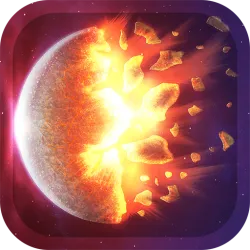
One of the most satisfying aspects of Solar Smash is the real-time visual feedback. As you unleash your chosen weapon, you’ll witness craters forming, oceans boiling, and landmasses shattering. The game’s physics engine, while not striving for absolute realism, delivers a believable and impactful sense of destruction. Watching a continent crumble under the sustained assault of a giant laser, or seeing the entire planet erupt in a fiery inferno after a well-placed black hole, is genuinely mesmerizing.
Beyond the initial destruction, Solar Smash also features some interesting post-impact observations. You can zoom in and out, rotate the camera, and even slow down time to truly appreciate the devastation you’ve wrought. This allows for detailed inspection of the planet's scarred surface, observing how the molten core might be exposed, or how fragmented pieces of the planet drift off into space. It’s these small details that elevate Solar Smash beyond a simple button-mashing exercise into a surprisingly contemplative experience of cosmic power. For those looking to dive into this destructive delight, you can find the game at Solar Smash.
Tips for the Aspiring Planet Destroyer
To get the most out of your Solar Smash experience, here are a few friendly tips:
- Experiment with everything: Don’t be afraid to try every weapon at your disposal. Each one offers a unique and satisfying way to dismantle a planet. You might discover a new favorite method of planetary demolition.
- Combine your attacks: While a single powerful weapon can be effective, the real fun begins when you combine different attacks. Soften up a planet with a few meteor strikes, then follow up with a laser to create massive fissures.
- Play with different planets: Each planet offers a fresh canvas for destruction. Observe how ice planets melt or how lava planets react to a cooling blast.
- Embrace the chaos: There’s no right or wrong way to play Solar Smash. It’s about personal enjoyment and the sheer spectacle of destruction. Let loose and have fun!
- Take your time: Don't rush through the destruction. Zoom in, observe the details, and appreciate the aftermath. Sometimes, watching the slow, agonizing demise of a planet is just as satisfying as the initial impact.
- Share your creations (or destructions!): Many players enjoy sharing screenshots or short videos of their most impressive planetary demolitions. Join online communities or forums to see what others have come up with and get inspiration for your next cosmic masterpiece.
Conclusion: A Universe at Your Fingertips
Solar Smash is more than just a game about blowing things up; it's a digital sandbox that offers a unique outlet for stress, a canvas for cosmic creativity, and a surprisingly awe-inspiring visual experience. Its simple mechanics make it accessible to anyone, while its diverse arsenal and captivating physics provide endless hours of destructive fun. So, if you’re looking for a game that lets you wield the power of the universe and leave your mark (or crater) on celestial bodies, Solar Smash is definitely worth exploring. Prepare to unleash your inner cosmic architect and reshape the cosmos, one shattered planet at a time.